
Review Date: October 1, 2026
This review may contain spoilers.
It’s been a hot minute since I’ve watched the OG Cloverfield, and to be honest, it was a lot better than I seem to have recalled. Also despite my having always associated Cloverfield with J.J. Abrams, who was one of the producers, I was a little surprised to see that it was, in fact, directed by a pre-Planet of the Apes, pre-The Batman Matthew Reeves. Perhaps I shouldn’t have been surprised considering how well-directed the movie was, considering the specific genre limitations of found-footage films. There’s always a conceit in the genre that despite whatever insanity is going on around the characters, one or more of them continue not only to film but nail the cinematography pretty well beyond the point when any sane person would have dropped the camera in favour of a chainsaw, shotgun, or some other weapon to protect against whatever existential threat they’re facing down, or just to book it in the opposite direction in adherence to the old adage that true survivors discretion is, indeed, the better part of valour.
With found footage films, there are really two levels of willing suspension of disbelief that the filmmakers have to maintain; that of the narrative itself, and also the reasoning for the continued filming of the people facing down the aliens or demons or redneck zombie torture families. Cloverfield does pass the test like many of its forebears, perhaps the most famous of which is The Blair Witch Project, but only a few films in the genre can I recall effectively bridge the gap between those two levels and offer adequate in-universe explanations for the dedication to the craft of film making in the face of annihilation. Those would be, in no particular order, Chronicle, Deadstream, and Ghostwatch, all of which are fantastic and I would highly recommend and also recommend while high.
Found footage also seems to be a natural fit for horror, as the audience expectation of lower-quality film quality offers a low barrier of entry for up-and-coming young filmmakers. What the genre of found footage does best is immerse the viewer in the world of the story, and Cloverfield embraces this element to full effect. Even though we as the audience know this isn’t really found footage, there’s a certain appeal to verisimilitude that does draw us in, when done well. Like the best in the genre, Cloverfield doesn’t drop us right into the action, but starts us off earlier getting to know our protagonists, in this case as they celebrate the departure of one of their number to bigger and better things as a vice president of something at a company in Japan and some of the interpersonal drama that those of us of a certain age look back at with nostalgia but only somebody still in their twenties would actually care about. The main cast of friends/acquaintances had some faces I recognized, and some I don’t recall seeing in any other projects: Lizzy Caplan, Jessica Lucas, T.J. Miller (before he went full T.J. Miller), Michael Stahl-David, Mike Vogel, and Odette Yustman. Lizzy Caplan and T.J. Miller at his least T.J. Miller-est (in the best possible way) are probably the biggest names to emerge in the years since (well, Lizzy Caplan already had Mean Girls under her belt at this point), but there are no weak links here.
What struck me watching Cloverfield in contrast to some recent movies and especially some recent horror movies is how the characters are actually allowed to breath and given space to experience and process the grief and loss from seeing friends and family die horribly in tentacle-bridge-related accidents or checks notes exploding in a shower of blood from an alien bug bite. It’s notable when Rob (Michael Stahl-David) gets a phone call from his mom (those cell phone networks are built to last like the Nokia product placement constantly reminds us) in a moment of respite from the alien kaiju rampaging in the streets above, the reality hits him and he goes off to a corner where he breaks down over the loss of his brother and is joined in his mourning by his brother’s fiance Lily (Jessica Lucas). Also, this was from a time when characters were actually allowed to get sweaty and dirty, so it really feels like you’re in the thick of it with them.
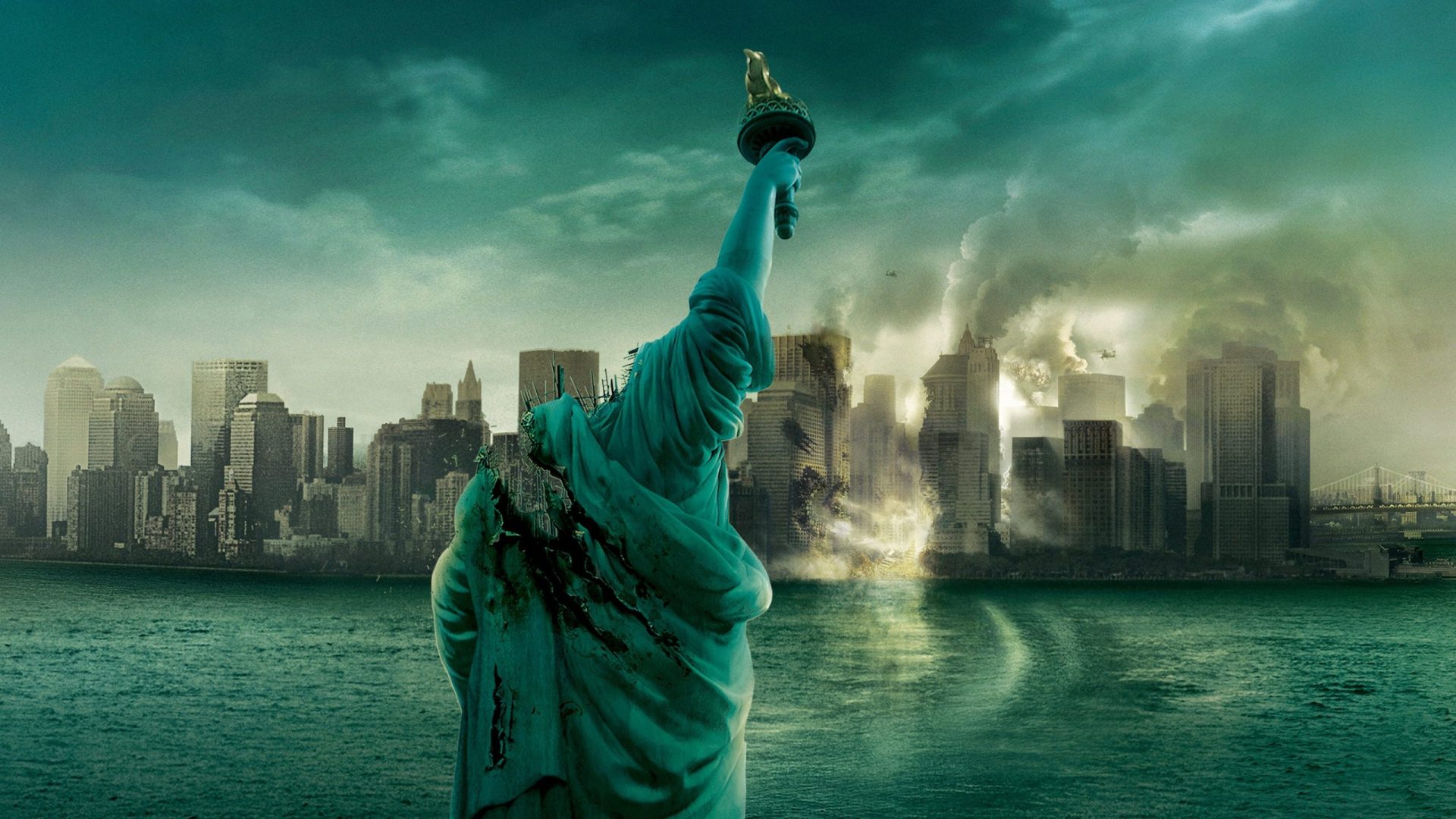
Cloverfield has got to be considered one of the all-time great found footage films, with possibly the second-best use of the Statue of Liberty as a prop to demonstrate the severity of the situation after the original Planet of the Apes. The tight script, development of the main characters, a truly unique creature design that is smartly only shown in small flashes, and effective world building that hints and teases rather than over explains are all essential ingredients in the effectiveness of this film. All of this coupled with the obvious 9/11 imagery after the initial kaiju attack results in a tense and engaging sci-fi horror film that doesn’t overstay its welcome and follows the George Costanza principle of leaving on a high note.
CLOVERFIELD (2008)
directed by: Matt Reeves
LINKS
Letterboxd | IMDb